
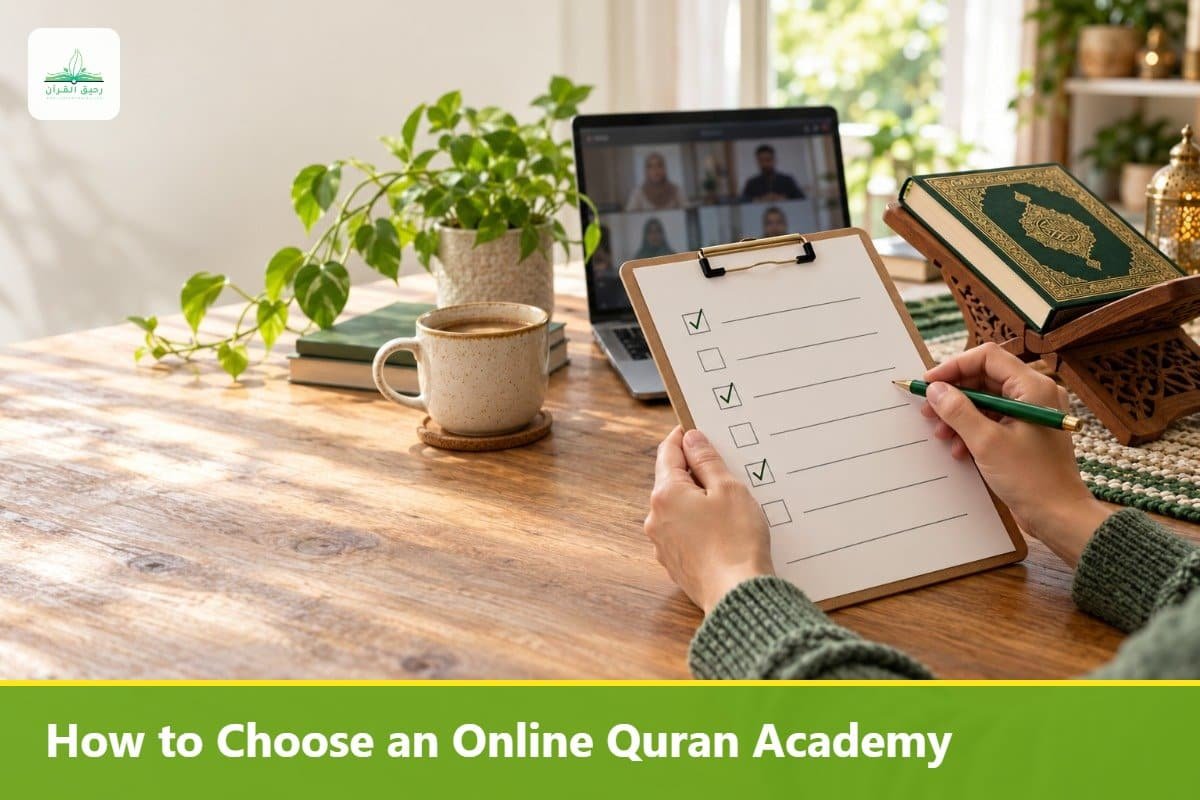
Choosing an online Quran academy is a decision that shapes how you or your child will recite for years. A good teacher builds habits that last a lifetime; a poor one builds mistakes that take a long time to undo. With so many websites offering classes, and most of them making similar promises, it helps to know exactly what to look for and which questions to ask before you pay for anything.
This checklist gives you ten practical points, a list of warning signs, and the questions worth asking during a trial lesson.
1. Teacher Qualifications
This comes first because everything else depends on it. Ask plainly: what qualifies your teachers to teach the Quran? Look for two things.
- Ijazah. An Ijazah is an authorisation from a qualified teacher confirming that the holder has recited the Quran correctly and may teach it. You can read more in our guide to what Ijazah means.
- Formal study. A degree from a recognised Islamic institution shows depth in the Quranic sciences, not only good recitation.
At Raheeq Alquran, tutors are graduates of Al-Azhar University who hold Ijazah to teach the Quran.
2. One-to-One or Group Classes
Learning to recite requires the teacher to hear you, specifically, and correct you, specifically. In a private lesson, all of the time is yours. In a group, your reading time is divided by the number of students. Groups can be useful for discussion-based subjects, but for reading, Tajweed and memorisation, one-to-one teaching is the most efficient format, especially for beginners and children.
3. A Free Trial Lesson
No description on a website can tell you how a teacher actually teaches. A trial lesson lets you judge the teacher’s manner, their recitation, their English, and how your child responds, before any commitment. An academy that is confident in its teachers is happy to offer one.
4. A Clear Curriculum
Ask what the path looks like from your current level. A well-organised academy can tell you which course you start with, what comes next, and how progress is measured. For example, a beginner typically moves from Noorani Qaida to recitation, then Tajweed, with memorisation for those who want it. If the answer is vague, the teaching often is too.
5. Female Teachers for Sisters and Girls
Many women and many parents of daughters prefer a female teacher. If that matters to you, confirm before booking that qualified female tutors are available at the times you need. We explain what to look for in our article on finding a female Quran teacher online.
6. Teaching in a Language You Understand
A teacher may recite beautifully and still struggle to explain a rule to a student who does not speak Arabic. During the trial, notice whether explanations are clear, whether the teacher checks that you have understood, and whether a young child can follow the instructions comfortably.
7. Experience With Your Age Group
Teaching a five-year-old, a teenager and a retired adult are three different skills. Children need short activities, patience and encouragement. Adults need clear explanations and respect for the courage it takes to begin. Tell the academy who the student is and ask for a teacher who is used to that age.
8. Flexible Scheduling and Consistency
Look for lesson times that fit your time zone and your routine, and ask two further questions: will I have the same teacher every lesson, and what happens if I need to reschedule? A consistent teacher who knows the student’s history makes much faster progress than a rotating series of teachers.
9. Transparent Pricing
Prices should be easy to find and easy to understand: how many classes a week, how long each class is, and what it costs. Be cautious where prices are hidden until after a sales call. You can see how plans are laid out on our pricing page.
10. A Safe Environment for Children
For parents, this is essential. A few sensible practices apply to any online class:
- Set the device up in a shared room, not behind a closed door.
- Stay within earshot, especially in the first lessons.
- Choose an academy that takes child safety seriously and welcomes parents observing.
- Keep communication between teacher and child within the lesson, with the parent as the point of contact.
Warning Signs to Watch For
- Guaranteed timelines. Promises such as completing memorisation or earning an Ijazah within a fixed short period, regardless of the student’s level. Honest teachers assess first.
- No information about teachers. If qualifications are never mentioned, ask why.
- No trial lesson.
- Pressure to pay for a long period in advance before you have experienced the teaching.
- Constant changes of teacher.
- Lessons where the student barely reads. If the teacher does most of the talking, little is being learned.
- No correction. A lesson without corrections is pleasant and useless.
Questions to Ask During the Trial Lesson
- What level am I, or is my child, at now?
- Which course should we begin with, and why?
- What will the first month cover?
- How much should we practise between lessons, and how?
- How will we know that progress is being made?
- Will we keep the same teacher?
The quality of the answers tells you a great deal. A good teacher gives specific, realistic answers and does not flatter.
What a Good First Lesson Looks Like
- The teacher greets the student warmly and puts them at ease.
- The student is asked to read, so the teacher can assess the real level.
- Mistakes are corrected kindly and clearly, with a demonstration.
- The student reads again and improves within the lesson.
- The lesson ends with a small, definite task to practise.
- You leave knowing where you stand and what comes next.
Cost and Value
The cheapest class is not always the best value, and neither is the most expensive. Value is progress per lesson. One focused, well-taught 30-minute private lesson can achieve more than several long group sessions. Compare what you actually receive: teacher qualifications, private attention, consistency and clear structure.
Frequently Asked Questions
Is learning the Quran online effective?
Yes, when it is live and one-to-one with a qualified teacher. The teacher hears every sound and corrects it immediately, as in person.
What equipment do I need?
A device with a camera and microphone, a stable internet connection and a quiet place. A headset improves the sound in both directions.
How many lessons a week are best?
Two or three suits most students. What matters equally is short daily practice between lessons.
From what age can children start?
When a child can sit and focus for a short lesson. The teacher can advise after a trial.
Can I change teacher if it is not a good fit?
You should be able to. Ask the academy how this works before you enrol.
See for Yourself
The simplest way to judge any academy is to take a lesson. At Raheeq Alquran, classes are one-to-one and live, with male and female tutors who are Al-Azhar graduates holding Ijazah, flexible scheduling, and a certificate on completing a course. Book a free trial class, bring the questions above, and decide with confidence. You can also browse our courses and meet our teachers.


No comment