
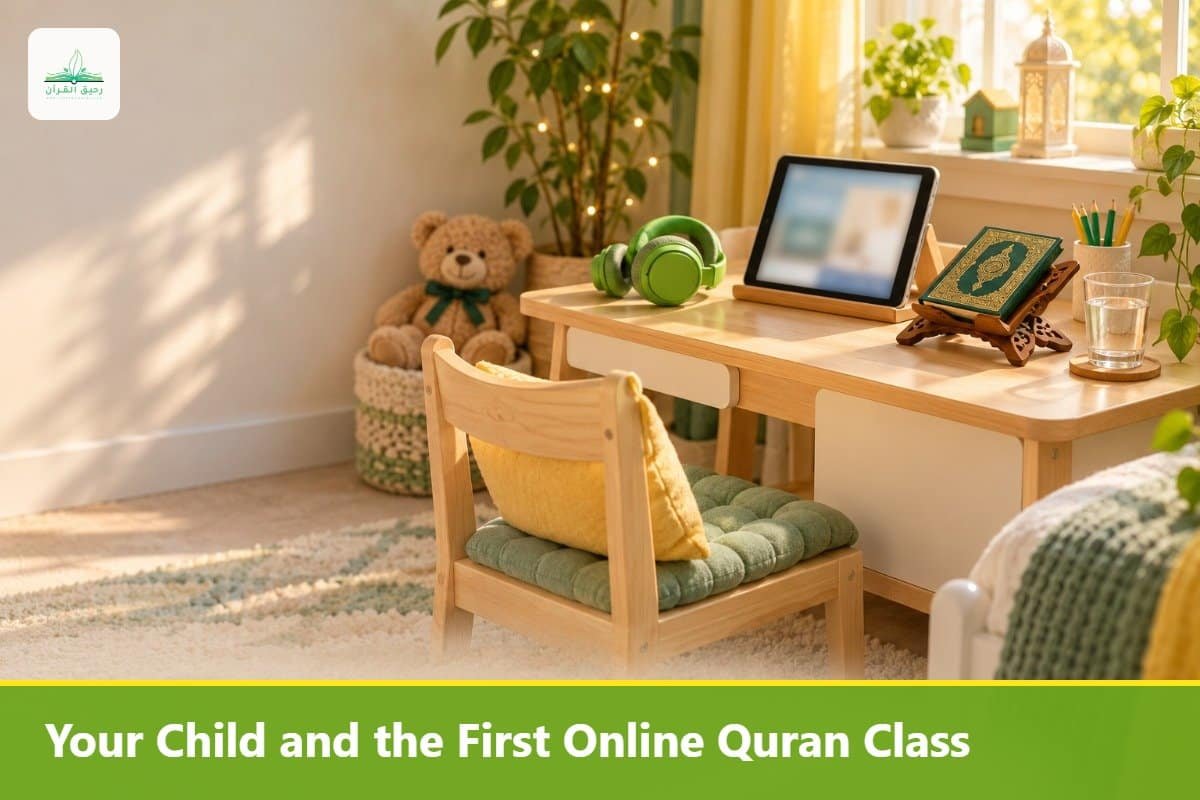
Your child’s first online Quran class sets the tone for everything that follows. A calm, well-prepared first lesson leaves a child thinking, I can do this, and looking forward to the next one. A rushed first lesson, with a device that will not connect and a nervous child pushed in front of a stranger, can create resistance that takes weeks to undo.
The good news is that a little preparation makes an enormous difference. This guide walks you through what to do in the days before, on the day, during the lesson and afterwards.
Start With Your Own Intention
Before any practical step, remind yourself why you are doing this. You are opening the Book of Allah to your child. The Prophet, peace be upon him, said: “The best of you are those who learn the Quran and teach it” (Sahih al-Bukhari). Your aim in the first weeks is not speed. It is for your child to love these lessons. Everything below serves that aim.
In the Days Before
Talk about it positively
Tell your child a few days ahead that they are going to meet a Quran teacher who will teach them to read the words of Allah. Speak about it as something special that they are now old enough for. Avoid presenting it as a duty, a test, or something that will take away play time.
Explain what will happen
Children are calmer when they know what to expect. In simple words: you will sit here, the teacher will appear on the screen and say salaam, they will ask your name, show you some letters and ask you to repeat. I will be right here. It will take about half an hour.
Let them help prepare
Let your child choose the notebook and pencil, help set up the desk, and decide where the Quran will go. A child who has helped prepare the space feels that the lesson belongs to them.
Choose the right time
Book the lesson for a time when your child is normally alert and fed, not immediately after school when they are tired and hungry, and not close to bedtime. For many children, late morning at the weekend or early evening after a snack and a rest works well.
Setting Up the Space
- A quiet spot in a shared room. Somewhere you can see and hear the lesson, away from the television and from siblings playing.
- A table and a chair of the right height. Sitting properly helps a child concentrate. Lessons on a bed or a sofa quickly become fidgety.
- Good light on your child’s face. The teacher needs to see their mouth to correct pronunciation. Light from the front is best; a bright window behind them turns them into a silhouette.
- A clear desk. Only what is needed: the device, the book, a pencil. Toys go out of reach.
- Water nearby, so there is no need to leave mid-lesson.
Setting Up the Technology
- Use a tablet or computer if you can. A larger screen makes the page easier to read than a phone.
- Stand the device at eye level, steady, so your child is not holding it.
- Use a headset. It lets your child hear the teacher clearly and lets the teacher hear the fine differences between letters. Child-sized headphones are worth having.
- Test everything the day before. Install the app the academy uses, check the camera, microphone and sound, and make sure the device is charged.
- Check your connection. Sit close to the router if the signal is weak.
- Silence notifications and close other apps.
- Log in five minutes early. Starting calmly is worth far more than those five minutes.
On the Day
- Make sure your child has eaten, had a drink and been to the toilet.
- Help them make wudu if they are old enough. It marks the lesson as something different from ordinary screen time.
- Dress as you would for a class at the mosque. It helps the child take it seriously.
- Stop play ten minutes before so the change is not abrupt.
- Stay relaxed yourself. Children read your mood instantly.
Your Role During the Lesson
For young children
Sit beside or just behind your child for the first lesson or two. Your presence is reassuring. Then gradually move further away as they settle, until you are nearby but not at their shoulder.
Let the teacher teach
This is the hardest part for parents. Do not whisper answers, repeat the teacher’s questions, or correct your child yourself. If your child goes quiet, give the teacher time. Experienced teachers know how to draw a shy child out, and they cannot do it if a parent keeps stepping in.
Stay within earshot
Even when your child is comfortable alone, remain where you can hear. You will know what was taught, and it is simply good practice for any online activity.
Do not judge the first lesson by how much was covered
A good first lesson is mostly about the teacher assessing your child’s level and building a connection. If your child smiled, spoke, and tried, it was a success.
After the Lesson
- Praise the effort specifically. I loved how carefully you listened, or you said that letter so clearly.
- Ask what they enjoyed, not what they got wrong.
- Do not quiz them immediately. Let them go and play.
- Note what the teacher asked them to practise and do it together for five minutes later that day or the next morning.
- Speak to the teacher briefly about your child’s level and the plan for the coming weeks.
Building the Routine
Once lessons are under way, three habits keep progress steady:
- Fixed lesson times each week, treated as firmly as school.
- Five to ten minutes of practice daily, at the same time each day.
- A simple chart where your child ticks off each practice.
If your child is beginning to memorise, our guide to a Hifz schedule for kids shows how to organise the week.
If Your Child Is Shy, Restless or Reluctant
- Shy: stay close at first, and tell the teacher beforehand. Most children open up by the second or third lesson.
- Restless: this is normal for young children. A good teacher varies the activities. Make sure the lesson is at a time of day when your child has energy to focus.
- Reluctant: avoid making it a battle. Keep the lead-up calm, keep your own tone warm, and connect the lesson with something pleasant afterwards.
- Tearful: end gently and try again. One difficult lesson means nothing about the future.
Frequently Asked Questions
At what age can a child start online Quran classes?
When they can sit and pay attention for a short lesson. Children differ, and a trial lesson is the easiest way to find out.
Should I sit with my child every time?
For the first lessons, yes if they are young. After that, stay nearby but let them work with the teacher independently.
What if my child does not know any Arabic letters?
That is where most children begin. The teacher starts from the first letter with a course such as Noorani Qaida.
Can I ask for a female teacher for my daughter?
Yes. Raheeq Alquran has both male and female tutors. Read more about choosing a female Quran teacher online.
How long is each class?
Our plans are based on 30-minute one-to-one classes.
Book the First Lesson
The first class at Raheeq Alquran is a free trial, so your child can meet the teacher with no pressure at all. Lessons are one-to-one and live, with tutors who are Al-Azhar graduates holding Ijazah, in a safe learning environment for children. Book a free trial class, and see our Quran for kids course for what your child will learn.


No comment