
For many Muslim families in Sweden, finding a Quran teacher is harder than finding a good school. Mosques and associations in the big cities run classes, but they are often full, held at fixed times, or far from home. In smaller towns there may be nothing regular at all. Online Quran classes in Sweden give families a reliable alternative: a qualified teacher, one to one, at home, explained in English.
This guide explains how online Quran learning works for families in Sweden, why many choose English as the teaching language, and how to fit lessons around Swedish school and work life.
Why online Quran classes make sense in Sweden
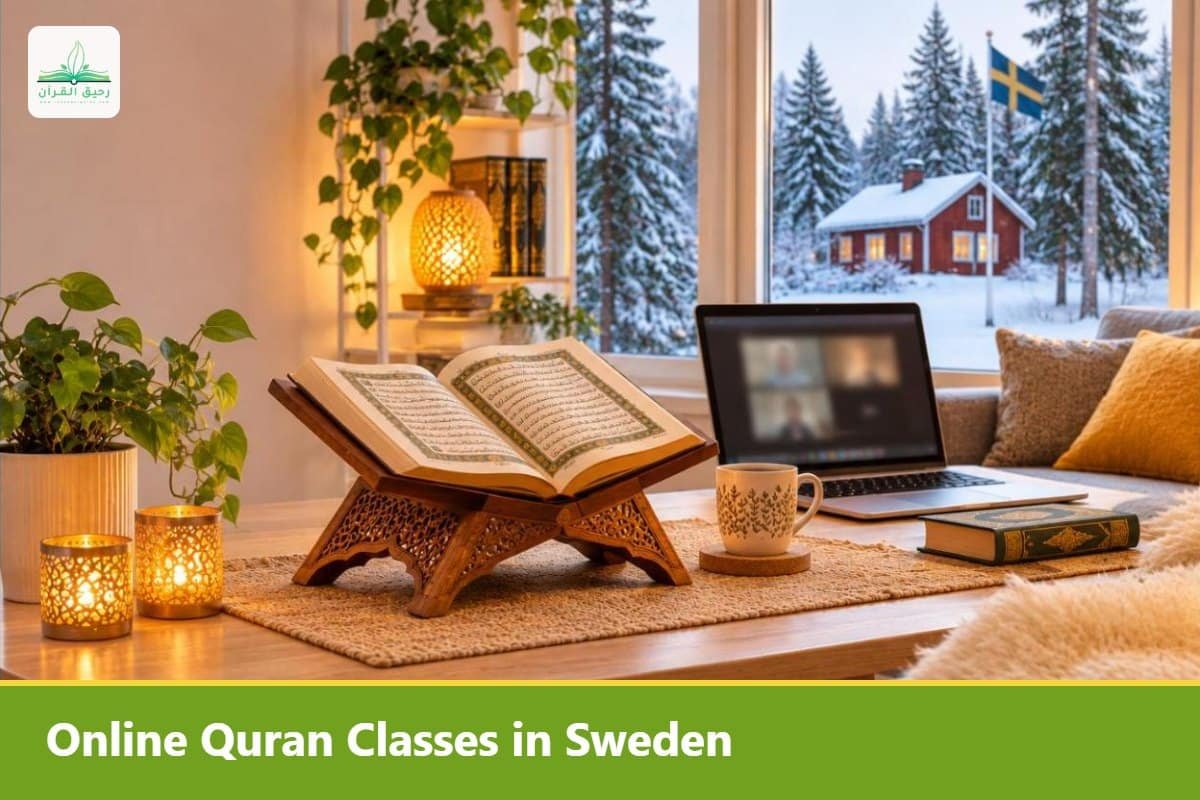
Online Quran classes make sense in Sweden because Muslim communities are spread across a large country, winters are long and dark, and family schedules are busy. Learning at home means no travel, no cancelled classes and a teacher fully focused on your child.
Sweden stretches more than 1,500 kilometres from north to south. A family in Kiruna, Sundsvall or Växjö may have no Quran teacher nearby, while a family in Stockholm or Gothenburg may face long waiting lists. Online, both get the same teacher and the same quality.
The winter months also matter. When it gets dark in mid-afternoon, a warm home lesson is far more realistic than taking young children out in the snow to an evening class.
Why learn the Quran in English in Sweden?
English works well as a teaching language in Sweden because most children and young adults speak it confidently, and it gives families from many different backgrounds one shared language for learning. The Quran itself is always recited in Arabic; English is only the language of explanation.
Swedish Muslim families come from Syria, Iraq, Somalia, Afghanistan, Bosnia, Turkey, Iran and many other countries. Children often speak Swedish at school, a heritage language at home, and English with ease. An English-speaking teacher can explain Tajweed rules, meanings and manners clearly, without the child struggling with a language they only half know.
Courses available for students in Sweden
Students in Sweden can follow the full path from the first Arabic letters to memorization and Arabic language. Every course is one to one, so the teacher can move faster or slower depending on the student.
- Noorani Qaida: letters, vowels and joining for beginners of any age.
- Quran recitation: fluent reading from the Mushaf with corrections.
- Tajweed: the rules that give recitation its correct sound.
- Hifz: a memorization plan with daily revision.
- Arabic: Quranic and classical Arabic to understand the meanings.
- Islamic studies: beliefs, worship, Seerah and character for children and adults.
How Quran lessons fit around Swedish school life
Most Swedish families book lessons after school and after-school club, typically between 16:00 and 19:00, or on weekend mornings. Short 30-minute lessons fit easily between dinner and homework.
Swedish schools finish relatively early, and many children attend an after-school club in the afternoon. A lesson at 17:00 or 18:00 works well for younger children, while teenagers often prefer later evening slots. Weekends are useful for longer revision.
School holidays such as the February sports break, the Easter break and the long summer break are ideal for extra lessons. Many families increase the number of classes during summer to make faster progress in memorization, then return to a lighter schedule in autumn. See weekly options on our pricing page.
Arabic at school versus Quran lessons
Arabic mother-tongue lessons at school and Quran lessons have different goals. School Arabic focuses on modern spoken and written language, while Quran lessons focus on correct recitation, Tajweed, memorization and understanding the Quran’s own language.
Both are valuable and they support each other. A child who reads Arabic letters at school will usually move through the Noorani Qaida quickly. But reading the Quran correctly needs specific training in pronunciation from the right points of articulation, elongation and pauses. Our articles on Makharij al-Huruf and Waqf (stopping signs) show how detailed this can be.
Ramadan and long summer days in Sweden
Ramadan in Sweden can be demanding when it falls in summer, because days are very long, especially in the north. Online lessons help because they can move to whatever time works best during the month, such as after Iftar or on weekend afternoons.
Many students use Ramadan to strengthen their recitation and complete a reading of the Quran with a teacher’s help. When Ramadan falls in winter, short days make fasting easier and leave long evenings for study and recitation.
Quran classes for adults, sisters and new Muslims in Sweden
Adults in Sweden learn the Quran for many reasons: to read for the first time, to correct their Tajweed, or to understand what they recite in prayer. A private online class lets them learn without embarrassment and at their own pace.
Sisters can request a female teacher; see our online Quran classes for ladies. Adults can explore our Quran classes for adults, and those who have recently embraced Islam can begin with our Quran classes for new Muslims.
Making progress between lessons
Real progress comes from small daily habits. Ten minutes of reading each day, one fixed time and a parent who listens matter more than adding extra classes.
- Choose a regular time, for example right after Maghrib or before bed.
- Keep the Mushaf or Qaida book in a dedicated spot.
- Listen to a clear reciter on Quran.com to train the ear.
- Revise old lessons regularly with our guide to Quran revision.
How to start online Quran classes from Sweden
To start, book a free trial lesson, meet the teacher, and agree on a starting level and schedule in Swedish time. After the trial you choose the number of 30-minute lessons per week that suits your family.
- Complete the form on our booking page and mention that you are in Sweden.
- Suggest a few preferred times in CET.
- Join the free trial with your child or on your own.
- Choose a weekly plan and begin.
Online Quran Classes in Sweden: FAQs
Are the lessons taught in English?
Yes. Lessons are explained in English, which suits Swedish families where children are comfortable in English, and the Quran itself is always recited in Arabic.
What time zone are the lessons in?
Lessons are scheduled in Swedish time (CET/CEST). The teacher keeps the same local time for you when Sweden changes its clocks.
My child already has Arabic at school. Do we still need Quran lessons?
Usually yes. Mother-tongue Arabic lessons at school focus on modern language, while Quran lessons focus on correct recitation, Tajweed and memorization.
Can we join from a small town in Sweden?
Yes. All you need is a stable internet connection, so families in Norrland, Småland or any small town get the same teacher as families in Stockholm.
Is a female teacher available?
Yes. Women and girls can request a female teacher for any course.
How do we start?
Book a free trial lesson, let the teacher assess the level, and then choose a weekly plan that fits your family.
Book your free trial from Sweden
Whether you live in Stockholm, Gothenburg, Malmö, Uppsala or a small town in the north, your family can start learning this week. Book your free trial lesson and meet a teacher who will help you read the Quran with confidence.


No comment