
The Netherlands has a large and long-established Muslim community, with families of Moroccan, Turkish, Surinamese, Somali, Syrian and many other backgrounds. Mosque weekend schools have taught generations of children to read the Quran. Yet many parents today find that weekend classes alone are not enough: groups are large, time with the teacher is short, and progress can be slow. Online Quran classes in the Netherlands add what is often missing, which is one-to-one attention at a time that suits the family.
This guide explains how online lessons work for Dutch families, how they fit around the Dutch school week, and how to start with a free trial.
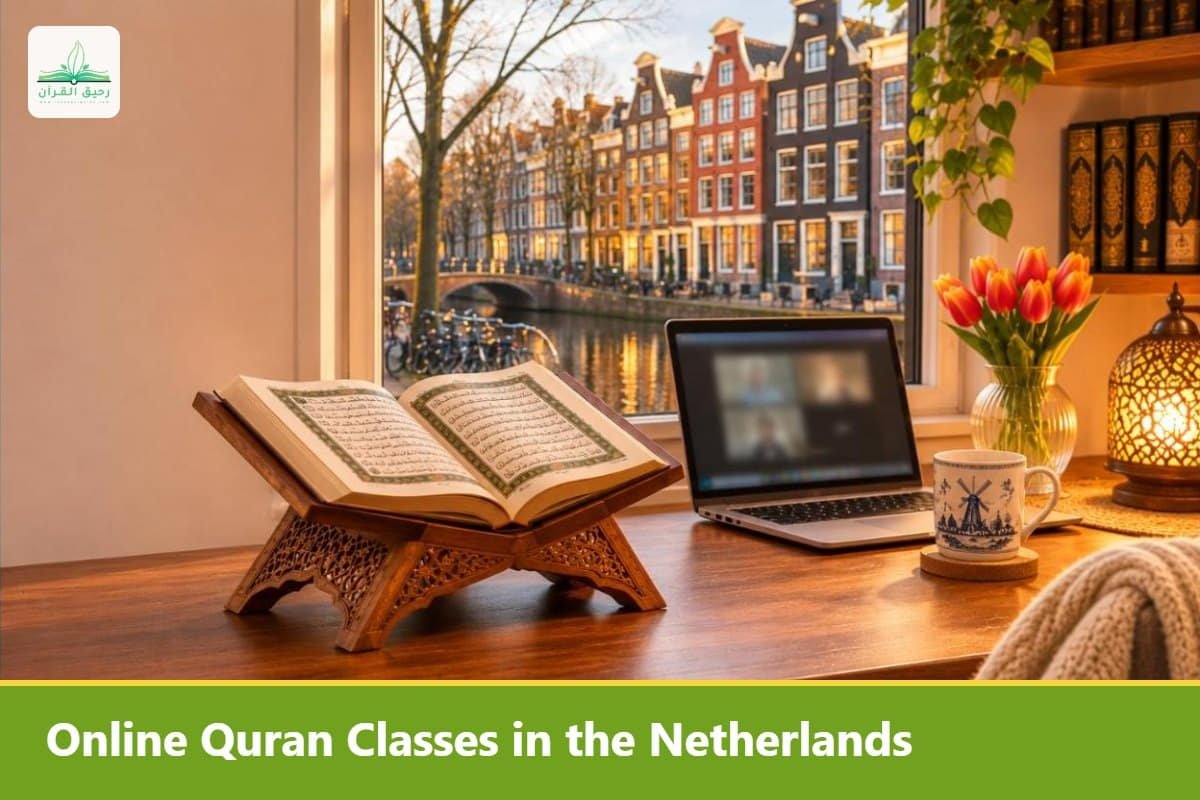
Why choose online Quran classes in the Netherlands?
Dutch families choose online Quran classes for personal attention, flexible timing and steady progress. In a private lesson the child reads for the full 30 minutes and every mistake is corrected, which is difficult in a weekend class with many students.
Weekend schools at the mosque have real strengths: friendships, Islamic identity and a sense of belonging. But a teacher with fifteen or twenty children can only listen to each child for a few minutes. Online lessons complement this by giving each child focused reading time with a qualified teacher several times a week.
Online classes also suit families in smaller towns in provinces such as Friesland, Drenthe or Zeeland, where a suitable teacher may not be close by.
Fitting lessons around the Dutch school week
Dutch school hours leave useful gaps for Quran lessons. Many primary schools finish early on Wednesday, and late afternoons, early evenings and weekend mornings are all popular times for 30-minute lessons.
A common pattern for primary-school children is a lesson on Wednesday afternoon, another on a weekday evening, and one on Saturday or Sunday. Older children in secondary school often prefer evening slots after homework. During school holidays such as the autumn break, the Christmas break and the long summer holiday, families can add extra lessons to speed up memorization.
Lessons are scheduled in Dutch time and follow the clock change automatically. See the weekly options on our pricing page.
Why lessons are taught in English
English is used to explain the lessons because it is widely spoken in the Netherlands and gives families of different backgrounds one shared language. The Quran is always recited in Arabic, and Arabic terms such as Tajweed rule names are taught in Arabic too.
For many Dutch children, English is their strongest language after Dutch. Explanations of Tajweed, meanings and Islamic manners in clear English are easy for them to follow, and they also strengthen the child’s English along the way.
What can students learn?
Students can learn everything from the first letters to full memorization. Each course is one to one, and the teacher adjusts the pace to the student’s level and goals.
For children
Children usually begin with the Noorani Qaida, then move on to reading the Quran and basic Tajweed for kids. Motivated children can join our Quran memorization course. Our Quran for kids page explains the approach.
For adults
Adults can learn to read for the first time, correct their recitation, or study Tajweed in depth. See our Quran classes for adults and advanced Tajweed course.
For sisters
Sisters can learn with a female teacher in our online Quran classes for ladies and Arabic for sisters course.
Arabic and Islamic studies
To understand the Quran, many students add Arabic courses or Islamic studies such as Aqidah, Fiqh and Seerah.
A typical online lesson
A typical lesson starts with revision, introduces one new point, and ends with a short practice task. The teacher listens closely and corrects pronunciation immediately, so mistakes do not become habits.
For example, a child working on the Qaida might revise yesterday’s letters, learn two new ones with their vowel marks, read short combinations, and then receive a page to practise at home. An adult studying Tajweed might review the rules of Meem Sakinah and then apply them to a passage from Surah Al-Mulk.
Online lessons and the weekend school: working together
Online lessons and mosque weekend schools work best together. The weekend school builds community and Islamic identity, while private online lessons give children the reading time and correction they need to progress quickly.
Some families tell the weekend school teacher about the online lessons so both can support the child. Others use online lessons in summer when the weekend school is closed. For a detailed comparison, read online Quran classes vs mosque classes and one-to-one vs group Quran classes.
Tips for parents in the Netherlands
Parents make the biggest difference between lessons. A short daily routine, a quiet learning corner and encouragement for effort will help your child more than any extra class.
- Choose fixed lesson times and keep them every week.
- Keep the tablet or laptop at eye level and use headphones.
- Listen to your child read for five minutes after dinner.
- Play a clear recitation in the car or before bed, for example from Quran.com.
- Read our tips on how to teach Quran to kids.
How to begin
Begin by booking a free trial lesson. The teacher will assess the student’s level, suggest a starting point and agree a schedule in Dutch time. After that, you choose how many 30-minute lessons per week suit you.
Ramadan and the seasons in the Netherlands
The Dutch seasons change daily routines a lot, and online lessons can change with them. In winter, short days and early Maghrib leave long evenings for recitation. In summer, Isha comes very late, so many families move lessons earlier in the day or to weekends.
Ramadan is a special opportunity. Many students increase their lessons during the month to improve their recitation, revise memorized surahs or complete a full reading of the Quran with their teacher. After Ramadan, a lighter plan helps keep the habit going rather than stopping completely.
Learning the Quran as a new Muslim in the Netherlands
New Muslims in the Netherlands often want to start with the essentials: reciting Al-Fatiha and short surahs correctly for prayer, understanding their meaning, and learning to read Arabic letters. A patient one-to-one teacher makes this much less intimidating. Our Quran classes for new Muslims are designed for exactly this first stage, and our guide to the Arabic alphabet for beginners is a helpful companion.
Online Quran Classes in the Netherlands: FAQs
Are the lessons in Dutch or English?
Lessons are explained in English, and the Quran is always recited in Arabic. Most Dutch children and adults follow English comfortably, which makes it a practical shared language.
Can online lessons replace the mosque weekend school?
They can, but many families use both. Weekend school offers community, while one-to-one online lessons give focused progress in reading, Tajweed and memorization.
What times are available?
Lessons are scheduled in Dutch time (CET/CEST), including after-school hours, Wednesday afternoons, evenings and weekends.
How young can my child start?
Many children start around four or five with short Noorani Qaida lessons. The free trial helps you see whether your child is ready.
Can adults learn Tajweed from scratch?
Yes. Adult beginners start with correct letter pronunciation and build up to full Tajweed rules at a comfortable pace.
Are female teachers available for sisters?
Yes. Women and girls can request a female teacher.
Book your free trial in the Netherlands
Whether you live in Amsterdam, Rotterdam, The Hague, Utrecht, Eindhoven or a small village, your family can start this week. Book your free trial lesson and meet a teacher who will guide you step by step.


No comment