
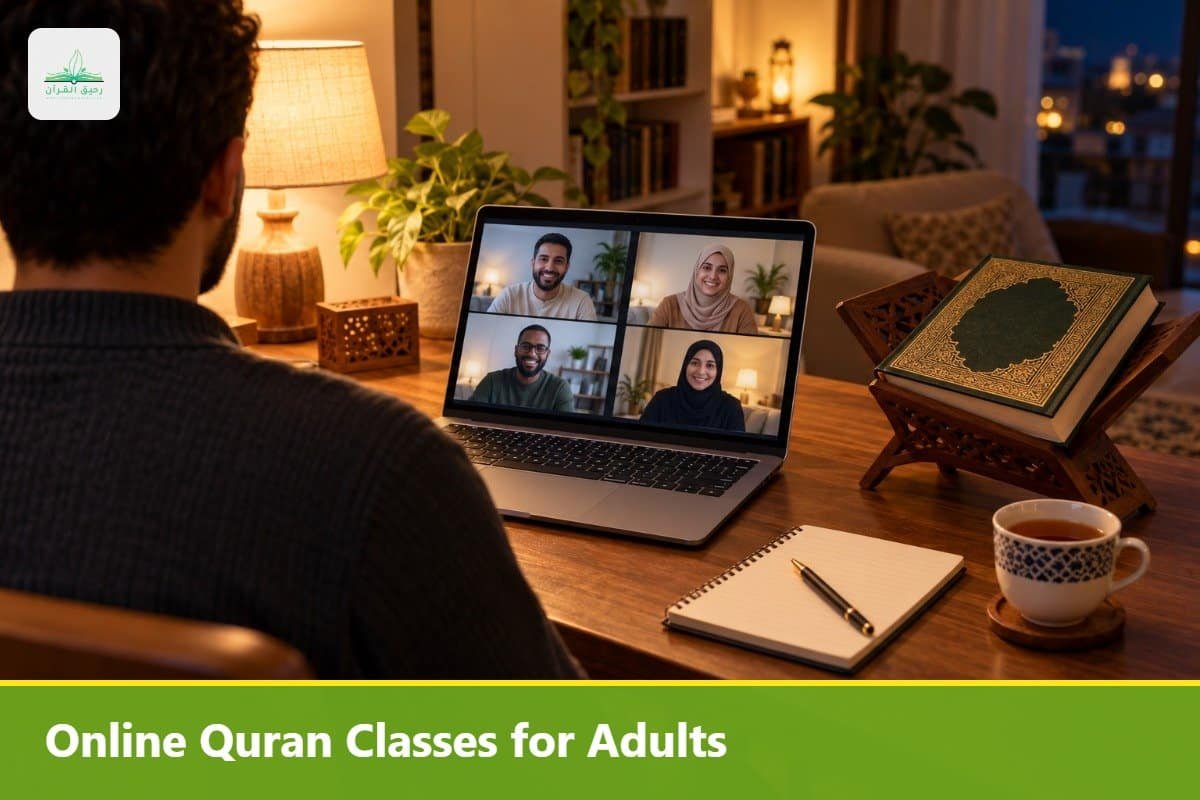
Online Quran classes for adults have opened a door that many people thought had closed years ago. If you never learned to read the Quran as a child, if you learned and then forgot, or if you can read but know your recitation has mistakes, you are far from alone. Many adults carry a quiet wish to read the Book of Allah properly, and many of them delay it for years because they feel embarrassed, busy, or simply unsure where to begin.
This guide explains how adult Quran learning works today, what you can realistically expect, and how to choose a path that fits your level and your life.
Why So Many Adults Are Starting Now
There are three common reasons adults give for not learning earlier: no qualified teacher nearby, no time that matches a mosque timetable, and the discomfort of sitting in a beginners’ circle next to children. Learning online removes all three. You study from home, at a time you choose, with a teacher who is focused only on you.
The Prophet, peace be upon him, said: “The best of you are those who learn the Quran and teach it” (Sahih al-Bukhari). There is no age limit in that statement. Many of the Companions accepted Islam and began learning the Quran as grown men and women, some of them in old age. Starting late is part of the tradition, not an exception to it.
What Level Are You? Four Common Starting Points
A good teacher will assess you in the first lesson, but it helps to know roughly where you stand.
1. Complete beginner
You do not know the Arabic letters, or you only recognise a few. Your starting point is a foundation course such as Noorani Qaida, which teaches the letters, their sounds, the short and long vowels, and how to join letters into words.
2. Slow reader
You know the letters and can work out words, but reading a line takes a long time and tires you. You need guided reading practice until the script becomes familiar. A Quran recitation course is designed for exactly this stage.
3. Fluent reader with mistakes
You read at a comfortable speed, but nobody has ever corrected your pronunciation or rules. This is where Tajweed comes in: correcting letter articulation, lengthening, nasal sounds and stopping.
4. Ready to memorise
Your reading is sound and you want to begin memorising, whether a few short surahs or a long-term plan. A structured Hifz programme with regular revision is the right fit.
How One-to-One Online Classes Work
In a one-to-one class there is one teacher and one student in a live video session. The teacher shares the page on screen, listens to you read, and corrects you on the spot. For adults this format has clear advantages:
- Privacy. Nobody else hears your mistakes. This matters more than most adults admit, and it is often the single thing that finally gets them started.
- Your pace. You can spend three lessons on one difficult letter without holding anyone back, or move quickly through what you already know.
- Full attention. Every minute of the lesson is your reading and your correction, instead of waiting for your turn in a group.
- Flexible timing. Lessons can be placed early in the morning, during a lunch break, or after the children are asleep.
At Raheeq Alquran, classes are one-to-one live sessions with male and female tutors who are graduates of Al-Azhar University and hold Ijazah in the Quran. Sisters who prefer a female teacher can request one.
What You Will Learn, Step by Step
Adult learning usually follows a clear order. Skipping steps feels faster but creates habits that are hard to fix later.
- Letters and sounds. Recognising each letter in its different positions and pronouncing it from the correct point in the mouth or throat.
- Vowels and joining. Fatha, kasra, damma, sukoon, shaddah and tanween, then reading two-letter and three-letter combinations.
- Reading words and verses. Moving from the Qaida to the mushaf itself, starting with short surahs.
- Basic Tajweed. The rules that affect meaning and clarity first, then the finer points.
- Fluency. Reading longer passages smoothly, with correct stops.
- Memorisation and understanding. Optional, and deeply rewarding once the reading is correct.
How Long Does It Take an Adult to Learn?
There is no honest single answer, because it depends on your starting level, how many lessons you take each week, and above all how much you practise between lessons. What can be said with confidence is this: an adult who attends regularly and practises for a short time every day makes steady, visible progress, while an adult who relies only on the lesson itself moves slowly.
Adults often worry that they learn more slowly than children. In reality adults have advantages: they understand explanations, they can follow written rules, and they are learning by choice. What children have is time and repetition. If you give yourself repetition, the gap closes.
Seven Practical Tips for Adult Learners
- Fix your lesson times. Treat them like an appointment you cannot move. Consistency matters more than length.
- Practise daily, even for ten minutes. A short daily review is worth more than one long session a week.
- Read aloud. Silent reading does not train the tongue. Your mouth has to learn the movements.
- Listen to a skilled reciter. Hearing the same passage you are studying trains your ear to notice your own mistakes.
- Record yourself. Listening back is uncomfortable at first and extremely effective.
- Do not hide your mistakes. The teacher is there for the mistakes. A lesson with no corrections is a lesson where you learned little.
- Renew your intention. You are learning to read the words of Allah. On the days when progress feels slow, remembering why you started is what keeps you going.
Common Worries, Answered Honestly
“I am too old to learn a new alphabet.”
The Arabic alphabet has 28 letters. Adults learn new systems at work all the time that are far more complex. The difficulty is not ability; it is regular exposure. With steady lessons the letters become familiar within weeks.
“My pronunciation will never sound right.”
Some Arabic sounds do not exist in English, and they feel strange at first. They are physical skills, like learning a new movement, and they improve with guided repetition. A teacher who can show you exactly where the sound comes from makes a large difference.
“I do not have time.”
Two or three lessons of 30 minutes a week, plus a few minutes of daily practice, is a realistic plan for a working adult or a busy parent. It is a small part of the week for something you may have wanted for years.
How to Choose the Right Class
Before you commit, look for these things:
- Teachers with recognised qualifications, such as Ijazah and formal study of the Quranic sciences.
- One-to-one lessons, so the pace is yours.
- The option of a female teacher if you want one.
- A free trial lesson, so you can judge the teacher and the method before paying.
- Clear plans and flexible scheduling.
You can see the available options on our courses page and the plans on the pricing page.
Frequently Asked Questions
Can I learn the Quran online with no Arabic at all?
Yes. Beginners start with the letters and sounds, and the teacher explains everything in English. You do not need to speak Arabic to learn to read the Quran correctly.
Are there female teachers for women?
Yes. Raheeq Alquran has both male and female tutors, and sisters can ask for a female teacher.
What do I need for the lessons?
A phone, tablet or computer with a camera and microphone, a stable internet connection, and a quiet place. A headset helps the teacher hear your pronunciation clearly.
How many lessons a week should an adult take?
Two or three lessons a week suits most adults. Fewer than that makes it easy to forget between lessons; more than that is useful if you have the time to practise.
Will I get a certificate?
Students receive a certificate after completing a course.
Take the First Step
The hardest lesson is the first one, and it is free. Book a free trial class with Raheeq Alquran, meet your teacher, find out your level, and see how learning the Quran can fit into your week. Whatever your age, the best time to begin is now.


No comment