
Many Canadian Muslim parents want their children to learn Arabic, for two reasons. First, it is the language of the Quran, and understanding it transforms prayer and recitation. Second, for families with Arab roots, it is a heritage language that connects children to grandparents and culture. Yet finding a good Arabic teacher for children in Canada can be hard. Online Arabic classes for kids in Canada bring a qualified teacher home for one-to-one lessons that build reading, writing, vocabulary and understanding, step by step.
This guide explains what children learn, how lessons work across Canadian time zones, and how parents can support progress at home.
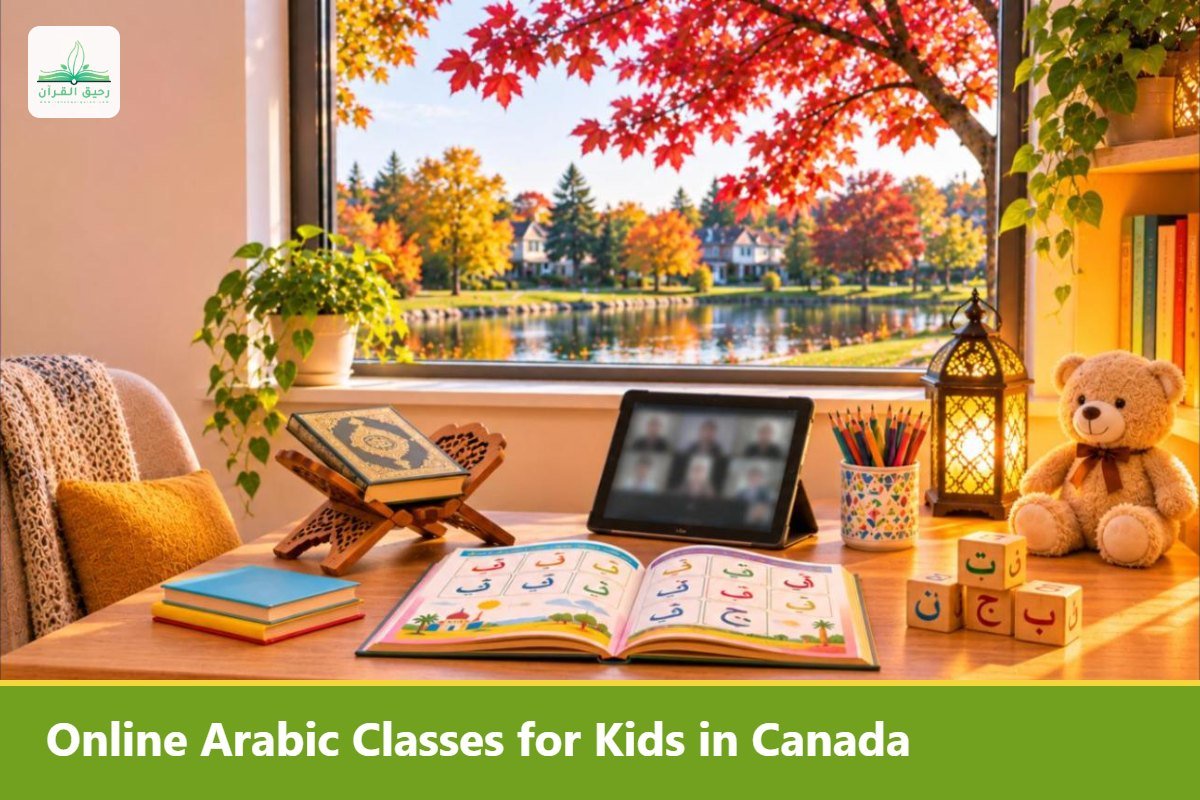
Why children should learn Arabic
Children who learn Arabic gain a deeper connection with the Quran, stronger reading skills and a link to one of the world’s great languages. Even basic Arabic helps children understand the words they recite in prayer every day.
Learning Arabic also supports Quran reading. Children who understand how Arabic words are built read the Quran more fluently and make fewer mistakes. For families of Arab heritage, it keeps the language alive across generations.
Arabic for children from non-Arabic-speaking homes
Children from Urdu, Somali, Bengali, Persian, English or other-speaking homes start from the beginning: letters and sounds, then simple words, short sentences and basic grammar. Lessons use pictures, repetition and simple conversations to keep learning fun.
Many of these children already know the letters from Quran lessons, which gives them a head start. The teacher builds on that knowledge and connects new vocabulary to familiar Quranic words.
Arabic for children from Arabic-speaking homes
Children from Arabic-speaking homes often understand their family’s dialect but cannot read or write standard Arabic confidently. Lessons focus on reading, writing, grammar and vocabulary in Fusha, building on what children already hear at home.
Many parents in Canada notice that children answer in English even when spoken to in Arabic. Regular lessons, combined with Arabic at home, help reverse that pattern and build confidence.
What children learn
A typical Arabic programme for children moves through clear stages, adapted to the child’s age and background.
- Letters and sounds: recognising and pronouncing each letter correctly.
- Reading and writing: joining letters, reading short words and writing them.
- Vocabulary: everyday words, numbers, colours, family and Quranic words.
- Simple sentences: introducing yourself, describing things and asking questions.
- Basic grammar: masculine and feminine, singular and plural, simple verbs.
- Reading short texts: stories and, later, simple passages linked to the Quran.
See our Arabic for kids course and the full range of Arabic courses.
Making Arabic fun for children
Children learn Arabic best when it feels like play. Teachers use games, songs, pictures, short stories and simple role-plays, and celebrate every new word. Our list of Arabic games for kids offers ideas for home practice too.
Combining Arabic and Quran lessons
Combining Arabic and Quran lessons helps both. A balanced plan for a nine-year-old might include three Quran lessons and two Arabic lessons a week, all 30 minutes long.
| Day | Lesson |
|---|---|
| Monday | Quran reading |
| Tuesday | Arabic for kids |
| Wednesday | Quran and Tajweed |
| Thursday | Arabic for kids |
| Saturday | Quran memorization |
Compare weekly options on our pricing page. For the Quran side, see our Quran for kids programme and our guide to online Quran classes for kids in Canada.
Learning across Canadian time zones
Lessons are booked in your local time, from Vancouver to Halifax. Most families choose after-school lessons on weekdays or weekend mornings. School breaks, especially summer, are ideal for extra Arabic lessons, since children have more time to practise.
Older children and teenagers
Older children and teenagers can move on to more structured courses such as the Madinah Arabic course, Arabic grammar or Arabic conversation. Those interested in the Quran’s language can explore Quranic Arabic.
How parents can help
Parents can help a great deal, whether or not they speak Arabic.
- Label household items with Arabic words.
- Learn a new word together each day.
- Use simple Arabic phrases at mealtimes.
- Read short Arabic picture books together.
- Ask your child to teach you what they learned.
How a lesson works
Each lesson is a 30-minute one-to-one video call. The teacher reviews previous words, introduces new ones with pictures and examples, practises reading and speaking, and sets a short task. You need a laptop or tablet, headphones with a microphone and a quiet space. Girls can request a female teacher.
How quickly will my child progress?
Progress depends on age, background and practice. Many children who start with the letters can read and write simple words within the first months, and children from Arabic-speaking homes often move faster in vocabulary while needing more work on reading and writing. The teacher tracks progress lesson by lesson and shares it with you, so you always know what your child has learned and what comes next.
Arabic and identity for Canadian children
For many Canadian children, learning Arabic becomes part of who they are. It helps them connect with grandparents, understand prayers and duas, and feel at home in their heritage while growing up Canadian. Children who can read Arabic also tend to feel more confident in Quran lessons and in Islamic school.
What to expect in the free trial
In the free trial, the teacher meets your child, checks letter recognition and reading, and asks a few simple questions to understand their level. You then receive a suggested starting point, a course recommendation and a weekly plan. Parents are welcome to join and share their goals.
Choosing the right teacher
A good Arabic teacher for children is patient, playful and organised. During the trial, notice whether your child is engaged and smiling, whether the teacher explains clearly at the right level, and whether there is a simple task to practise afterwards. Girls can request a female teacher.
Short tips for practising Arabic at home
Five minutes a day of Arabic at home makes lessons far more effective. Try naming objects at dinner in Arabic, singing a simple Arabic song in the car, or reading one short page together before bed. Small, regular moments keep new words fresh between lessons.
Online Arabic Classes for Kids in Canada: FAQs
What age can children start learning Arabic online?
Many children start around five or six with letters, sounds and simple words. Older children can begin at any age with a level-appropriate plan.
Is the Arabic taught Quranic Arabic or spoken Arabic?
Children learn standard Arabic (Fusha), the language of the Quran and of reading and writing. Some courses also include conversation.
Can Arabic lessons be combined with Quran lessons?
Yes. Many children take Quran and Arabic lessons in the same weekly plan, which helps both.
Our family speaks Arabic at home. Are lessons still useful?
Yes. Children from Arabic-speaking homes often understand dialect but struggle to read and write standard Arabic. Lessons build those skills.
Which time zones are available?
All Canadian time zones. Lesson times are agreed in your local time.
Is the first lesson free?
Yes. The first lesson is a free trial to assess your child’s level.
Book your child’s free Arabic trial
Give your child the gift of Arabic. Book your free trial lesson, tell us your child’s age and background, and meet a teacher who will build a fun, structured plan. For more about learning across the country, read our guide to online Quran classes in Canada.


No comment