
Finding a good Quran teacher in Canada is not always easy. In big cities the nearest Islamic centre may be a long drive away, weekend classes fill up quickly, and in smaller towns there may be no regular class at all. Add a Canadian winter, school runs and work shifts, and many families simply give up. Online Quran classes in Canada solve most of these problems: a qualified teacher comes to your living room through a screen, at a time that suits your province and your routine.
This guide explains how online Quran lessons work for Canadian families and adults, what to look for in a teacher, which course suits which learner, and how to start with a free trial.
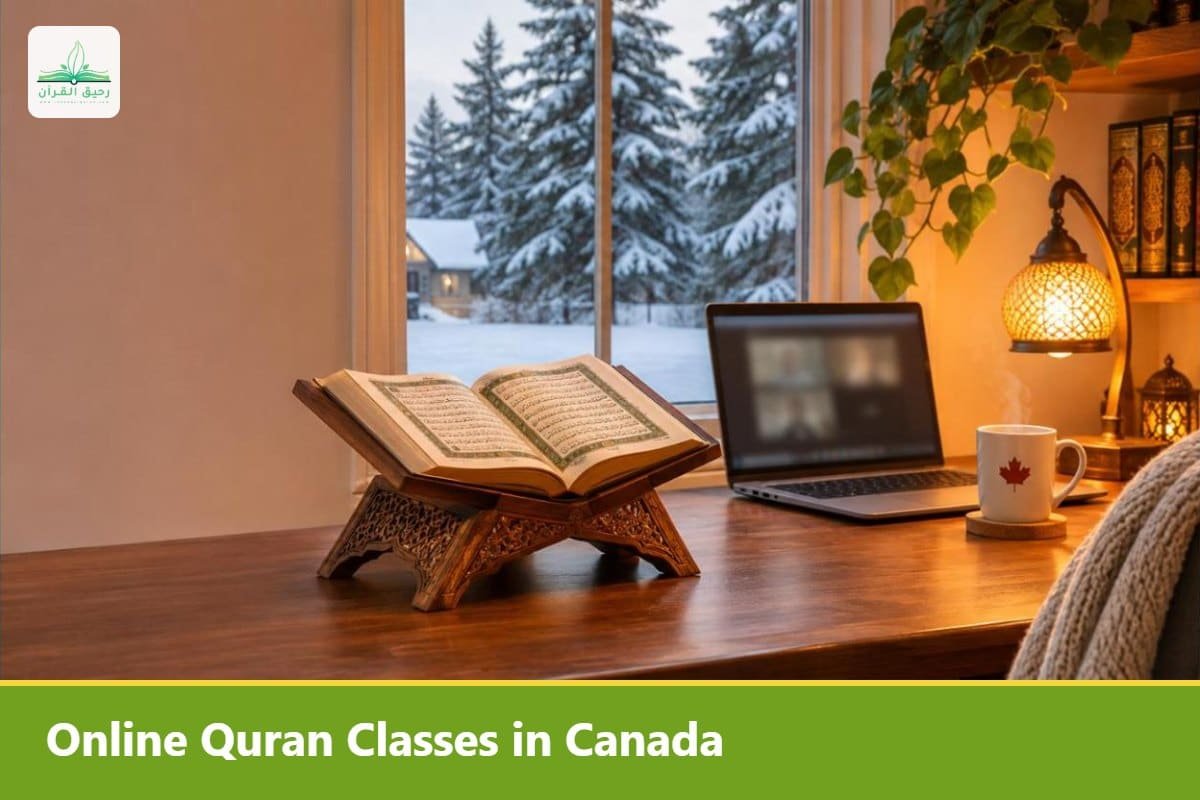
Why online Quran classes work so well in Canada
Online Quran classes work well in Canada because they remove the three biggest obstacles Canadian Muslims face: distance, weather and time. Lessons happen at home, they are not cancelled by snowstorms, and they can be booked early in the morning, after school or late in the evening in any Canadian time zone.
Canada is a huge country with six time zones. A family in Vancouver and a family in Halifax live more than four hours apart, yet both can book a teacher at a convenient local time. That flexibility is hard to match with an in-person class that runs once a week at a fixed hour.
There is also the question of attention. In a busy weekend class one teacher might listen to fifteen children, so each child reads for only a few minutes. In a one-to-one online lesson your child reads for the whole session, and the teacher corrects every mistake as it happens.
Who can benefit from online Quran lessons?
Almost anyone who wants to read, understand or memorize the Quran can benefit, from a four-year-old learning the alphabet to a grandparent who wants to correct their recitation. Lessons are one to one, so the pace and content change with the learner rather than with a group.
Children and teenagers
Children usually start with the Noorani Qaida, which teaches the Arabic letters, vowels and joining rules in small steps. Once they can read fluently they move to reading the Quran itself, basic Tajweed and memorizing short surahs. Our Quran for kids course keeps lessons short, active and encouraging.
Adults and new Muslims
Many adults in Canada grew up without regular Quran lessons, or learned to read but never studied Tajweed. Adult learners often feel shy about starting again. A private online class removes that pressure. See our Quran classes for adults and our guide on Quran classes for new Muslims.
Sisters who prefer a female teacher
Women and girls can request a female teacher. Many sisters find it easier to recite, ask questions and correct pronunciation with a teacher they feel fully comfortable with. Read more about our online Quran classes for ladies.
Courses you can take from anywhere in Canada
The most popular courses for Canadian students cover reading, Tajweed, memorization and Arabic. You can start with one course and move to the next when you are ready, without changing teacher.
- Noorani Qaida: the foundation for reading Arabic letters correctly.
- Quran reading: fluent reading from the Mushaf with correct pronunciation. See online Quran reading.
- Tajweed: the rules of recitation, from Noon Sakinah to Madd. Explore our Tajweed courses.
- Hifz (memorization): a structured plan with daily new lessons and revision. See Quran memorization course.
- Arabic language: Quranic and classical Arabic to understand what you recite. Browse Arabic courses.
- Islamic studies: Aqidah, Fiqh, Seerah and Hadith for children and adults. See Islamic courses.
How a typical online lesson works
A typical lesson lasts 30 minutes, one to one, over a video call. The teacher listens, corrects pronunciation in real time, explains one new point, and sets a short practice task for the next class. Parents can sit nearby and follow progress.
The first few minutes are usually revision of the previous lesson. Then the teacher introduces something new, such as a new group of letters, a Tajweed rule or the next few verses for memorization. The student reads, the teacher corrects, and the student reads again until the sound is right. The lesson ends with a small, realistic goal for the coming days.
Because the class is private, nothing is skipped. If a child struggles with the difference between similar letters such as ha and kha, the teacher can spend the whole lesson on it. If an adult moves quickly, the teacher moves quickly too.
Fitting Quran lessons into Canadian school and work life
The best schedule is the one you can keep. For most Canadian families that means two to four short lessons a week, booked at the same times each week, so that Quran becomes part of the routine rather than an extra task.
Some practical ideas that work well for families we teach:
- Before school: a 30-minute lesson at 7:00 am, when children are fresh.
- After school snack time: a short lesson before homework begins.
- Weekend mornings: longer revision or two back-to-back lessons for older students.
- Late evenings for adults: a lesson after the children are asleep.
During Ramadan many students increase their lessons, and in summer, when school is out, it is a good time to push memorization forward. Your plan can change with the seasons. You can compare weekly plans on our pricing page.
What to look for in an online Quran teacher
A good online Quran teacher has a correct, well-trained recitation, experience teaching your type of learner, patience, and a clear plan. Ask about the teacher’s background, how progress is tracked, and whether you can try a lesson first.
Before you commit, it helps to ask:
- Is the teacher a native Arabic speaker with a sound Tajweed background?
- Does the teacher have experience with children, beginners or adults like me?
- Is there a clear curriculum, or does each lesson start from scratch?
- Will I receive feedback on progress?
- Can I change the time or pause if life gets busy?
For a deeper checklist, read our article on how to choose an online Quran academy.
Online classes or a local mosque class?
Both have real value. A mosque class gives children community and friendships, while online lessons give one-to-one attention and flexible timing. Many Canadian families combine them: weekend school at the masjid for community, and private online lessons for reading and memorization.
If you are deciding between the two, our comparison of online Quran classes vs mosque classes walks through the pros and cons in detail.
Helping your child succeed between lessons
Progress happens between lessons as much as in them. Ten minutes of daily reading, a fixed place for the Mushaf and a parent who listens make a bigger difference than adding more classes.
- Keep a small Quran corner with good light and a stand.
- Ask your child to read the last lesson to you once a day.
- Praise effort, not only results.
- Listen to a clear reciter together in the car or at bedtime. Resources such as Quran.com make this easy.
Our guide on preparing your child for the first online Quran class has more tips for young learners.
How to start online Quran classes in Canada
Starting is simple: book a free trial lesson, meet the teacher, and agree on a level and schedule. After the trial you choose how many 30-minute lessons per week you want, and the teacher builds a plan around your goals.
- Fill in the short form on our booking page and mention your city and preferred times.
- Attend the free trial with your child or on your own.
- Receive a suggested starting level and course.
- Choose a weekly plan and begin regular lessons.
Online Quran Classes in Canada: Frequently Asked Questions
Can I find lesson times that suit my province?
Yes. Teachers work across many hours of the day, so families in Vancouver, Calgary, Toronto, Montreal or Halifax can book times that fit their own local schedule, including early mornings, evenings and weekends.
What age can my child start online Quran classes?
Many children start around four or five years old with short Noorani Qaida lessons. The right age depends on attention span more than a number, and the free trial helps you judge readiness.
Do I need to know Arabic before joining?
No. Complete beginners start with the Arabic letters and their sounds, then move step by step to joining letters and reading words from the Quran.
Is a female teacher available for my daughter or for me?
Yes. Sisters and girls can request a female teacher, so lessons stay comfortable for those who prefer it.
How long is each lesson?
Standard lessons are 30 minutes, one to one. You choose how many lessons per week, from one class up to daily practice.
What do I need for the lessons?
A laptop or tablet, a stable internet connection, headphones with a microphone and a quiet corner. Your teacher shares the reading material on screen.
Book your free trial today
Whether you live in a big city or a small town, from British Columbia to Nova Scotia, you do not have to wait for a local class to open. Book your free trial lesson and let a qualified teacher help you or your child read the Quran with confidence.


No comment