
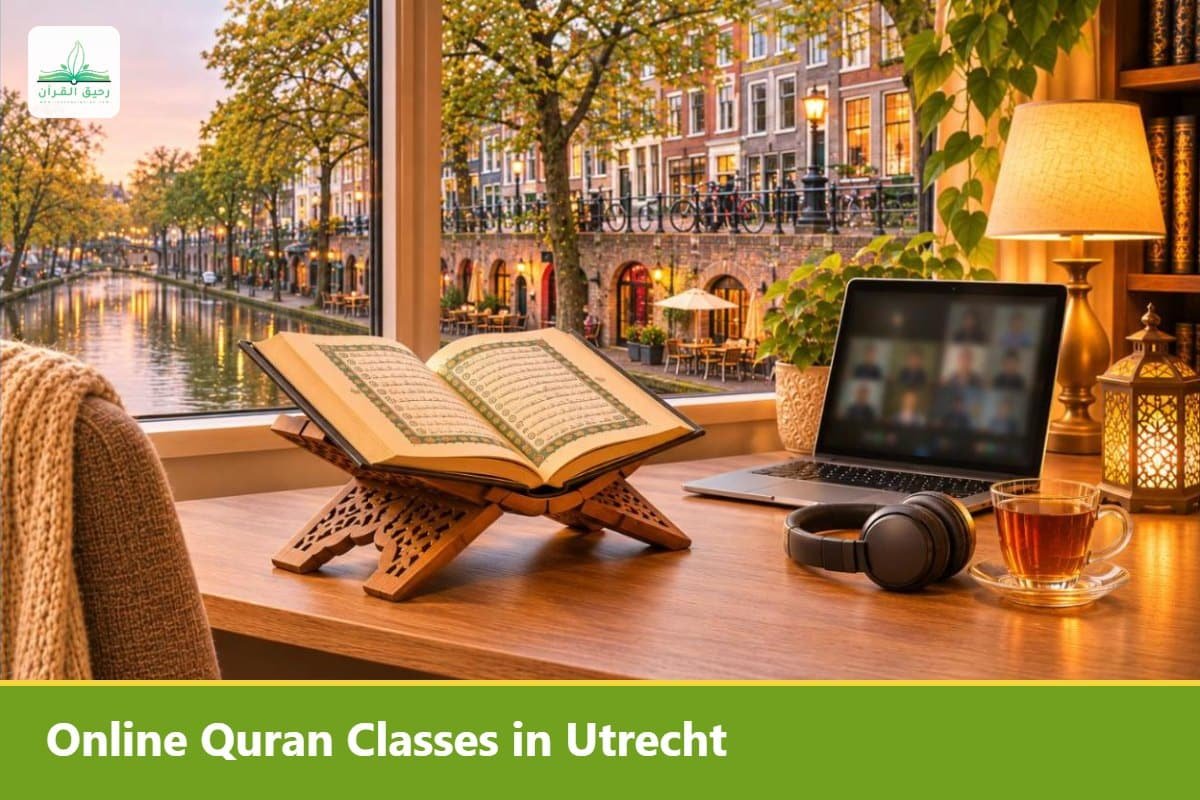
Utrecht sits at the heart of the Netherlands, a busy university city surrounded by growing towns such as Nieuwegein, Houten and Zeist. Its Muslim community, concentrated in neighbourhoods like Kanaleneiland, Overvecht and Lombok but spread across the region, includes families, university students and young professionals. Many of them can already read the Quran but want to recite it correctly and beautifully. Others are complete beginners. Online Quran classes in Utrecht meet both needs with private, English-taught lessons at home.
This guide follows the journey from the first letters to confident Tajweed and explains how online lessons make each step easier for Utrecht learners.
Why choose online Quran classes in Utrecht?
Learners in Utrecht choose online Quran classes for personal attention, flexible timing and convenience. In a private lesson every word you read is heard and corrected, which is the fastest way to improve recitation and build lasting confidence.
Utrecht’s students and commuters live tightly scheduled lives. Online lessons can be booked early in the morning, between lectures or late in the evening, without cycling across the city in the rain. For parents, lessons at home mean one less trip in an already busy week.
Step 1: The foundation for beginners
Beginners start with the Noorani Qaida, which teaches the shapes and sounds of the Arabic letters, the vowels and how letters join. A strong foundation here makes everything that follows easier.
The teacher pays special attention to sounds that do not exist in Dutch or English, such as ain, ha and qaf, and to pairs of letters that are easily confused. Learn more in our Noorani Qaida course, the Arabic alphabet for beginners and our guide to Makharij al-Huruf.
Step 2: Reading fluently from the Mushaf
Once the Qaida is complete, students move to reading directly from the Quran. The teacher listens to every word and corrects mistakes immediately so that fluency grows on a correct foundation.
This stage builds speed and confidence. Students practise daily, read longer passages over time and start to recognise common words and patterns. Our guide to learning to read the Quran online explains how to progress efficiently.
Step 3: Tajweed, the art of correct recitation
Tajweed is the set of rules that gives the Quran its correct pronunciation and rhythm. It covers how letters are pronounced, when sounds are merged or hidden, how long vowels are stretched and where to pause.
Many Utrecht learners who read fluently discover that their recitation has small but important mistakes: heavy letters pronounced lightly, rushed elongation or missed nasal sounds. A teacher can identify these quickly and work through them systematically. Key topics include:
- Noon Sakinah and Tanween
- Meem Sakinah
- Madd (elongation)
- Qalqalah
- Heavy and light letters
- Waqf (stopping signs)
Explore our Tajweed courses, from Tajweed for beginners to the advanced Tajweed course.
Step 4: Memorization and beyond
With correct reading and Tajweed in place, many students begin memorizing. A good Hifz plan balances new verses with regular revision and is checked in every lesson.
Children and adults can join the Quran memorization course. Advanced students may later work towards an Ijazah; see our Ijazah courses and the guide to what an Ijazah in Quran is.
Online Quran lessons for children in Utrecht
Children in Utrecht follow the same journey at a pace suited to their age. Lessons are short, encouraging and varied, with lots of praise and small goals.
Most families book lessons on Wednesday afternoons, weekday evenings or weekend mornings. Children who attend weekend mosque school often add two or three online lessons for extra reading time. See our Quran for kids and Tajweed for kids programmes.
Teenagers and university students
Teenagers and students often want more than reading: they want to recite beautifully, memorize meaningful surahs and understand what they recite. One-to-one lessons let them set their own goals and work towards them with a teacher who respects their maturity.
Students at Utrecht’s universities and colleges often choose two lessons a week, lighter during exams and heavier during breaks. Our article on how to learn the Quran when you’re busy offers practical tips.
Adults, sisters and new Muslims
Adults can learn privately at their own pace, whether they are starting from zero or refining their Tajweed. See our Quran classes for adults and Tajweed for adults.
Sisters can request a female teacher through our online Quran classes for ladies. New Muslims can begin with Al-Fatiha and short surahs in our Quran classes for new Muslims.
Choosing your weekly plan
Choose a plan that matches your goal. Beginners and children usually need three or four short lessons a week, Tajweed students two or three, and those memorizing four or five.
Lessons are scheduled in Dutch time and follow the clock changes automatically. Compare weekly options on our pricing page.
Getting the most from each lesson
A little preparation and daily practice make each lesson far more productive. Use headphones with a microphone, keep the Mushaf on a stand, and spend ten minutes a day revising what you learned.
Recording yourself reading and comparing it with a skilled reciter is another powerful habit, especially for Tajweed students. Our guide on how to improve your Quran recitation explains more techniques.
Online lessons and the mosque community
Online lessons work best alongside your local mosque, not instead of it. The mosque gives your family community, Friday prayers, Eid and Ramadan programmes, while the online teacher provides one-to-one reading time and precise correction during the week.
Many Utrecht parents keep their children in weekend classes for friendship and Islamic identity and add online lessons for faster progress. If you are weighing the two, our comparison of online Quran classes vs mosque classes explains the strengths of each.
Ramadan and the Dutch seasons
The Dutch seasons change prayer times and daily routines a great deal, and online lessons adapt easily. In winter, early Maghrib leaves long evenings for recitation practice. In summer, Isha comes very late, so many families move lessons earlier in the day or to weekends.
During Ramadan, many students increase their lessons to polish their Tajweed, revise memorized surahs or complete a reading of the Quran with their teacher. After Eid, a steady weekly plan helps keep that progress alive throughout the year.
Online Quran Classes in Utrecht: FAQs
Can families in Nieuwegein, Zeist, Houten or Amersfoort join?
Yes. Lessons are online, so families anywhere in the province of Utrecht, or the wider Netherlands, can join.
I already read the Quran. Is a Tajweed course right for me?
Yes. Many students read fluently but have never studied Tajweed. A teacher will assess your recitation and focus on the rules and letters you need most.
Are lessons suitable for teenagers?
Yes. Teenagers receive lessons that respect their maturity, with clear goals for Tajweed, memorization or understanding.
What language are lessons taught in?
Lessons are explained in English, and the Quran is always recited in Arabic.
Is a female teacher available?
Yes. Girls and sisters can request a female teacher.
How do I start?
Book a free trial lesson, meet your teacher and agree on a level and weekly schedule.
Book your free trial in Utrecht
From Kanaleneiland to Leidsche Rijn and from Zeist to Nieuwegein, you can start this week. Book your free trial lesson and meet a teacher who will guide you from your current level to confident, beautiful recitation. For more about learning across the country, read our guide to online Quran classes in the Netherlands.


No comment