
Arabic matters to many Australian families. For families of Lebanese, Iraqi, Syrian, Egyptian, Palestinian and other Arab heritage, it is the language of grandparents and family history. For families from Pakistan, Afghanistan, Indonesia, Turkey, Somalia and elsewhere, it is the language of the Quran. Either way, children growing up in Australia often speak English everywhere and struggle to read or write Arabic. Online Arabic classes for kids in Australia help children read, write and understand standard Arabic, with one-to-one lessons at home in your own time zone.
This guide explains what children learn, how lessons fit around school, and how parents can support progress at home.
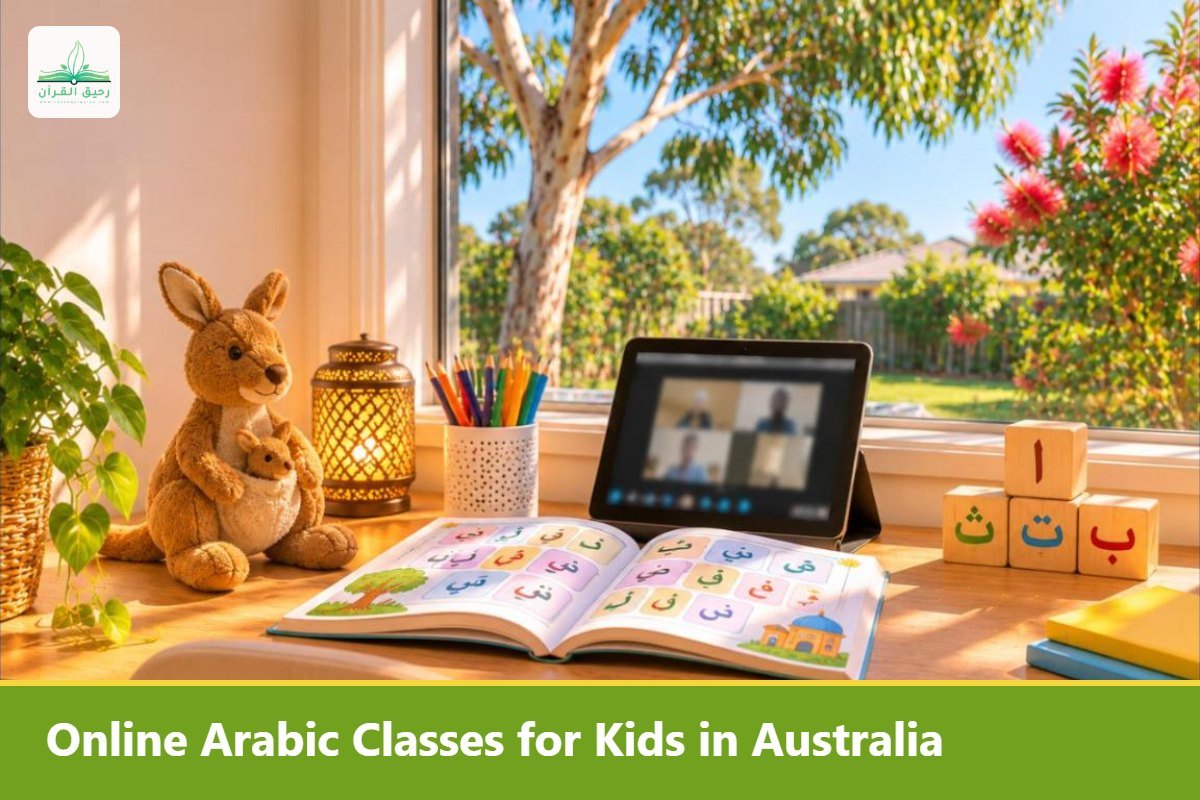
Why children should learn Arabic
Children who learn Arabic gain a deeper connection with the Quran, stronger reading skills and a link to a major world language. Even basic Arabic helps children understand the words they recite in prayer every day, and makes Quran reading more fluent and confident.
For children of Arab heritage, Arabic connects them with relatives overseas and with their family’s culture. Many Australian parents notice their children answering in English even when spoken to in Arabic; regular lessons help reverse that pattern. Online Arabic classes for kids in Australia give every learner this kind of personal attention.
For children from Arabic-speaking homes
Children who hear Lebanese, Iraqi, Egyptian or another dialect at home usually understand a lot but cannot read or write standard Arabic confidently. Lessons focus on reading, writing, grammar and vocabulary in Fusha, building on familiar words and showing how dialect connects to the standard language. Our online Arabic classes for kids in Australia are designed with exactly this in mind.
For children from non-Arabic-speaking homes
Children from Urdu, Dari, Bahasa, Turkish, Somali, English or other-speaking homes start from the beginning: letters and sounds, then words, short sentences and simple grammar. Many already know the letters from Quran lessons, which gives them a head start. Families comparing online Arabic classes for kids in Australia should ask how a teacher handles this.
What children learn
- Letters and sounds: correct pronunciation of every letter.
- Reading and writing: joining letters, reading and writing words.
- Vocabulary: everyday words, numbers, colours, family and common Quranic words.
- Sentences: introducing yourself, describing things and asking questions.
- Grammar: masculine and feminine, singular and plural, simple verbs.
- Reading texts: short stories and simple passages linked to the Quran.
See our Arabic for kids course and all Arabic courses.
Arabic at school and at home
Some Australian schools and community language schools offer Arabic. Private online lessons work well alongside them, giving each child one-to-one time to strengthen reading, writing and speaking. For students preparing for Arabic in their final school years, focused lessons can help build confidence in grammar and comprehension. Students in online Arabic classes for kids in Australia practise this step by step, with gentle correction.
Making Arabic fun
Children learn Arabic best when it feels like play. Teachers use pictures, songs, games, short stories and role-plays, and celebrate every new word. Our list of Arabic games for kids has ideas for home practice too. Good online Arabic classes for kids in Australia keep a healthy balance between progress and enjoyment.
A balanced weekly plan
| Day | Lesson |
|---|---|
| Monday | Quran reading |
| Tuesday | Arabic for kids |
| Wednesday | Quran and Tajweed |
| Thursday | Arabic for kids |
| Sunday | Quran memorization and revision |
Lessons are booked in your local time. Compare weekly options on our pricing page.
Arabic and the Quran together
Arabic and Quran lessons support each other. Children who understand Arabic read the Quran with more meaning and fewer mistakes, while daily Quran reading builds Arabic vocabulary. See our Quran for kids programme and the guide to online Quran classes for kids in Australia. This works well for both children and adults taking online Arabic classes for kids in Australia.
Older children and teenagers
Older children and teenagers can move on to the Madinah Arabic course, Arabic grammar, Arabic conversation or Quranic Arabic. Teenagers interested in the Quran’s meaning can also explore the Tafseer course. Progress in online Arabic classes for kids in Australia is reviewed regularly, so nothing important is missed.
How parents can help
- Use simple Arabic phrases at home every day.
- Label household items with Arabic words.
- Read short Arabic picture books together.
- Ask your child to teach you a new word after each lesson.
- Connect Arabic words to the surahs your child recites.
How quickly will my child progress?
Progress depends on age, background and practice. Children starting from zero can often read and write simple words within the first months, while children from Arabic-speaking homes usually move faster in vocabulary. The teacher shares progress regularly so you always know what comes next. Many learners join online Arabic classes for kids in Australia with exactly this goal in mind.
How a lesson works
Each lesson is a 30-minute one-to-one video call. The teacher reviews previous words, introduces new ones with pictures and examples, practises reading, writing and speaking, and sets a short task. You need a laptop or tablet, headphones with a microphone and a quiet space. Girls can request a female teacher. The free trial is the simplest way to see whether online Arabic classes for kids in Australia suit your family.
What to expect in the free trial
In the free trial, the teacher meets your child, checks letter recognition and reading, and asks a few simple questions to understand their level. You then receive a suggested starting point, course and weekly plan. There is no obligation to continue. Online Arabic classes for kids in Australia make this easier, because the teacher adapts to each learner.
Choosing the right teacher
A good Arabic teacher for children is patient, playful and well organised. During the trial, notice whether your child is engaged and smiling, whether explanations are clear and at the right level, and whether there is a simple task to practise afterwards. Girls can request a female teacher. That is why online Arabic classes for kids in Australia are built around short, regular one-to-one lessons.
Short tips for practising at home
Five minutes a day of Arabic at home makes lessons far more effective. Try naming objects at dinner in Arabic, singing a simple Arabic song in the car, or reading one short page together before bed. Small, regular moments keep new words fresh between lessons and show your child that Arabic belongs in everyday family life. Parents often say this flexibility is what they value most about online Arabic classes for kids in Australia.
Arabic and grandparents
For many children, the most rewarding moment comes when they can read a short message or say a full sentence in Arabic to a grandparent, in Australia or overseas. These moments make lessons meaningful and motivate children to keep going. Encourage your child to send a short voice message in Arabic to relatives after each new milestone. Teachers in our online Arabic classes for kids in Australia follow this approach from the very first lesson.
Over time, these small moments of real-life use matter as much as lessons themselves. A child who uses Arabic with family, even a little, remembers far more and sees the language as part of who they are.
Between lessons, you can listen to clear recitations of every surah on Quran.com, a helpful free resource for revision and listening practice.
Online Arabic Classes for Kids in Australia: FAQs
Is the Arabic taught standard Arabic or a dialect?
Children learn standard Arabic (Fusha), the language of the Quran and of reading and writing. Some courses also include conversation practice.
My child already hears Arabic at home. Will lessons still help?
Yes. Many children understand a dialect but cannot read or write confidently. Lessons build reading, writing and grammar on top of what they already know.
Can online lessons support Arabic at school?
Yes. Some Australian schools offer Arabic as a subject, and one-to-one lessons can strengthen a child’s reading, writing and vocabulary alongside school learning.
What age can children start?
Many children start around five or six with letters and simple words. Older children start at a level that suits them.
Can Arabic and Quran lessons be combined?
Yes. Many children take both in one weekly plan, which helps reading and understanding.
Is the first lesson free?
Yes. The first lesson is a free trial to assess your child’s level.
Book your child’s free Arabic trial
Help your child read, write and understand Arabic. Book your free trial lesson, tell us your child’s age and home language, and meet a teacher who will build a fun, structured plan. For more, read our Australia guide.


No comment