
Across Australia, many Muslims learned to read the Quran in weekend madrasah or from a parent, but never had their recitation checked letter by letter by a qualified teacher. Others taught themselves as adults. The result is often recitation that is fluent but carries small mistakes in pronunciation, elongation or stopping. Online Tajweed classes in Australia solve this with one-to-one lessons in your own time zone, where a teacher hears every letter and corrects it precisely.
This guide explains what Tajweed is, the signs that your recitation needs work, a typical syllabus, and how online lessons work across Australia.
What is Tajweed?
Tajweed is the science of reciting the Quran correctly: pronouncing each letter from its proper point of articulation, giving it its proper qualities, and applying the rules of merging, hiding, elongation and stopping. It preserves the recitation of the Quran as it was taught by the Prophet, peace be upon him, and passed down through generations of teachers.
Some mistakes only reduce the beauty of the recitation, but others can change a word into a different word with a different meaning. That is why scholars have always emphasised learning Tajweed with a teacher.
Five signs your recitation needs Tajweed
- You are not sure where to stop and start in a long verse.
- Letters like ha and ain sound similar when you read.
- Heavy letters such as sad and ta sound like their lighter partners.
- You are unsure how long to hold each elongation.
- You skip the nasal sound on noon and meem with Shaddah.
If any of these sound familiar, a few months of focused Tajweed lessons can make a big difference.
Why Tajweed must be learned one to one
Tajweed depends on sound, and only a teacher listening closely can hear the details. In a one-to-one online lesson, the teacher hears every letter you pronounce and corrects it on the spot. Books and apps can explain rules, but they cannot hear your mistakes. Read our comparison of one-to-one vs group Quran classes.
A typical Tajweed syllabus
- Makharij al-Huruf: points of articulation.
- Heavy and light letters: Tafkheem and Tarqeeq.
- Noon Sakinah and Tanween: Izhar, Idgham, Iqlab and Ikhfa.
- Meem Sakinah.
- Qalqalah.
- Madd: types and lengths of elongation.
- Sun and moon letters and other lam rules.
- Waqf: stopping and starting correctly.
How online Tajweed lessons work
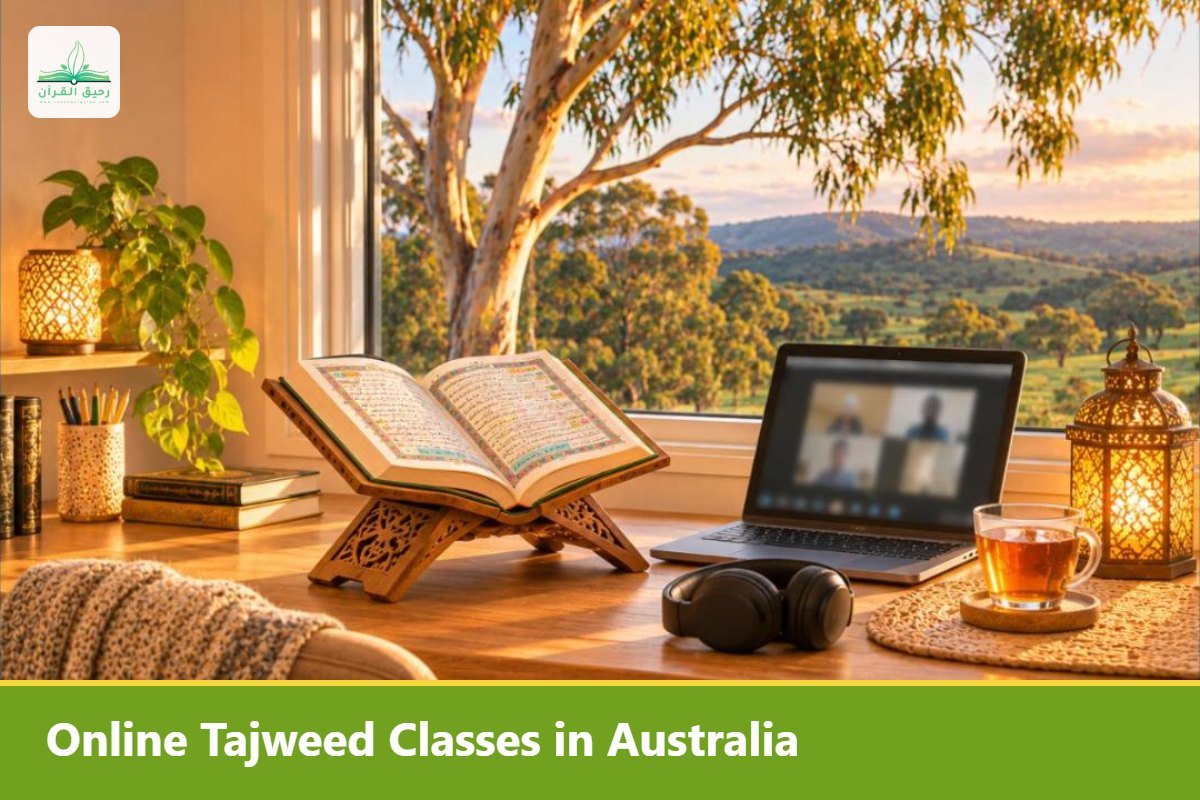
Each lesson is a 30-minute one-to-one video call. The teacher reviews the previous rule, explains a new one with examples, listens as you recite a passage, corrects mistakes immediately and sets a short practice task. The teacher can share the Mushaf on screen and highlight letters and rules. You need a laptop or tablet, headphones with a microphone and a quiet space.
Learning across Australian time zones
Lessons are booked in your local time, whether you live in Perth, Darwin, Adelaide, Brisbane, Sydney, Melbourne, Canberra or Hobart, and adjusted for daylight saving in the states that use it. Early mornings, evenings and weekends are all popular. For city-specific advice, see our guides to Sydney, Melbourne, Brisbane, Perth and Adelaide.
Tajweed courses for every learner
- Tajweed for beginners: the core rules step by step.
- Tajweed for adults: correcting long-standing habits privately.
- Tajweed for kids: simplified rules with repetition.
- Tajweed classes for sisters: with a female teacher.
- Advanced Tajweed: in-depth study and classical texts.
All options are listed on our Tajweed courses page. Students who need to strengthen reading first can start with the Noorani Qaida.
How many lessons a week?
Two or three 30-minute lessons a week suit most adult and teenage Tajweed students, with ten minutes of daily practice. Children usually do best with three or four shorter sessions. Compare weekly options on our pricing page.
Practising between lessons
Turn rules into habits by reciting your assigned passage every day, listening to skilled reciters, and recording yourself once a week to compare. Focus on one rule at a time until it becomes natural. Our guide on improving your Quran recitation has more tips.
How your Tajweed assessment works
In the free trial, you recite a short passage you know well. The teacher listens for the throat and heavy letters, the length of each Madd, nasal sounds, the rules of Noon and Meem Sakinah, and where you pause. You then receive an honest summary of your strengths, the two or three corrections that matter most, and a suggested course and weekly plan.
Tajweed for teenagers and young adults
Many young Australians read fluently after years of madrasah but want to recite like the reciters they admire. Private Tajweed lessons give them that skill with dignity and privacy. Improving recitation often builds confidence to lead prayers at home or recite at community events.
Ramadan: the perfect time to apply Tajweed
Ramadan is ideal for applying Tajweed, because you recite more than in any other month. Choose one rule to perfect during the month and ask your teacher to focus on it in every lesson.
From Tajweed to Ijazah
Advanced students can work towards an Ijazah, a certified chain of recitation. Read what an Ijazah in Quran is and explore our Ijazah courses, including the Jazariyyah programme.
Learning Tajweed with a busy Australian schedule
If you work full-time, study or care for a family, two short lessons a week and ten minutes of daily practice are enough for steady progress. Many Australians practise during the commute, listening to a skilled reciter in the car or on the train, and then recite their assigned passage before bed. Consistency matters far more than long sessions.
Tajweed and your family
When parents study Tajweed, the whole family benefits. You begin to hear your children’s mistakes clearly and can guide them gently at home, and children see that learning the Quran is a lifelong journey rather than something only for kids. Some families hold a short weekly recitation where everyone recites a passage and the others listen for one rule.
Sisters learning Tajweed
Many sisters prefer a female Tajweed teacher, especially when reciting aloud and repeating sounds many times. See our Tajweed classes for sisters.
Online Tajweed Classes in Australia: FAQs
Do I need to read fluently before learning Tajweed?
It helps, but it is not essential. The teacher assesses your reading and either starts Tajweed straight away or strengthens your reading first.
How long does it take to learn the core rules?
It depends on frequency and practice, but students taking two or three lessons a week usually cover the core rules within several months and keep refining them.
Which time zones do you teach in?
All Australian time zones. Lessons are booked in your local time, including daylight saving where it applies.
Can children learn Tajweed online?
Yes. Children learn simplified Tajweed once they read fluently, with plenty of repetition.
Is a female Tajweed teacher available?
Yes. Sisters and girls can request a female teacher.
Is the first lesson free?
Yes. The first lesson is a free trial in which the teacher assesses your recitation.
Book your free Tajweed assessment
Find out exactly where your recitation stands. Book your free trial lesson, recite a short passage, and receive a clear plan for improving your Tajweed, wherever you live in Australia. For more, read our Australia guide.


No comment